
Repopulation Nation: Why Is Everyone Suddenly Obsessed With My Uterus?
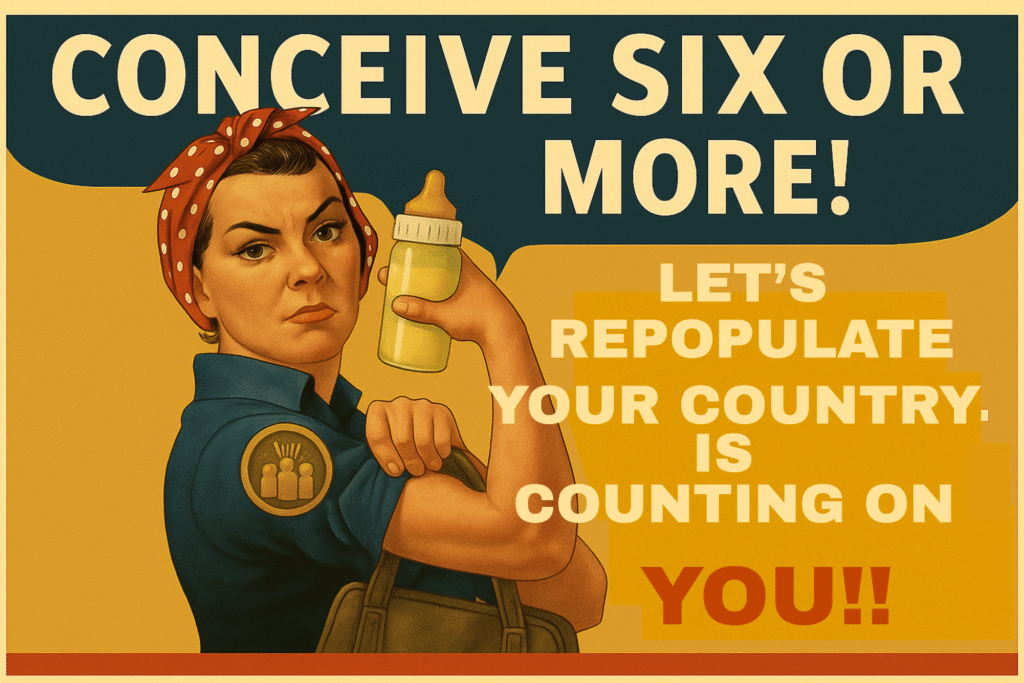
“Apparently it’s my civic duty to repopulate the earth while housing prices look like Powerball numbers and maternity leave is still a fantasy novel.”
If that sounds absurd, that’s because it is. We are living in a timeline where politicians, economists, and tech bros have suddenly decided it’s time to nationalize the uterus. The birth rate is dropping, and everyone from policy analysts to billionaires is panicking. There’s just one problem: the people who are actually capable of giving birth? We’re not panicking. We’re paying attention. Let’s break down this hysteria, and why the most rational response might just be: no thanks
Let’s take a tour through the madness, shall we?
The Birth Rate Has Dropped…And Everyone’s Lost Their Minds
In case you missed it while doomscrolling through climate disasters and celebrity breakups, people aren’t having as many babies. According to the CDC, the U.S. birth rate has fallen to 1.62 births per woman…the lowest ever recorded (CDC, 2024).
This isn’t just happening in the U.S. Japan is literally offering financial incentives and matchmaking services to encourage people to breed (BBC, 2023). Hungary’s government will forgive your mortgage if you pop out a third kid (Reuters, 2020). And Elon Musk, expert on literally everything except humility, has declared that “population collapse” is a bigger threat than climate change (MSN, 2022).
So now, policymakers, think tanks, and tech bros are all leaning in with the same creepy question:
“Why won’t you just have the baby?”
And here’s where things get truly unsettling:
We’re not just talking about trends. We’re talking about literal strangers, politicians, economists, and CEOs publicly debating who should be having children, how many, and under what circumstances…as if our bodies are community property.
It’s creepy.
It’s a modern echo of old-world control and the idea that women’s bodies are somehow national assets. That the uterus is an economic lever you can just pull when the GDP gets shaky. That if we could just get enough middle-class couples to “circle back” to baby-making, the global economy could calm down.
Let’s pause on that for a second.
If someone on the street asked you how many children you plan to have and whether your reproductive choices aligned with your country’s fiscal outlook…you’d call the police.
But when it’s printed in The Wall Street Journal, we’re supposed to take it seriously instead of seeing it for what it is: a soft invasion of autonomy, wrapped in the language of public policy.
The fact that this is a normal conversation in powerful spaces, without addressing the actual lived experiences of the people being discussed…should give all of us pause. Because when your fertility becomes a think tank topic, it’s no longer a personal decision. It’s a spreadsheet row.
Why We’re Saying “Maybe Not”
I don’t know, just spitballing here, but maybe people are hesitant to have kids because the world currently feels like a mashup between The Hunger Games and a late-stage capitalism fever dream?
Let’s go through the completely normal, not-at-all-terrifying checklist:
- The average cost to raise a child in the U.S. is now over $310,000 (Brookings, 2022).
- Childcare costs more than college tuition in 34 states (Child Care Aware, 2023).
- The U.S. is one of the only wealthy countries with zero guaranteed paid parental leave (OECD, 2023).
- Housing prices are up 47% since 2020 (Redfin, 2024).
- Birth can bankrupt you. The average cost of giving birth with insurance is $18,865 (KFF, 2022).
But yes, let’s make it about my avocado toast again. The truth? We’re not “too lazy” or “too career-focused” to have children. We’re simply not interested in walking headfirst into financial ruin and emotional depletion without structural support.
Maybe We’re Not Broken. Maybe We’re Just…Noticing Things.
Here’s a radical thought: maybe choosing not to have children right now is a sign of emotional intelligence — not a moral failure. We’re the generation raised on economic recessions, climate warnings, student debt, mass shootings, and burnout as a baseline. Add the pressure to “do it all,” and somehow we’re still expected to keep society functioning by repopulating it?
People love to say, “It’s always been hard to raise kids.”
Sure.
But it’s never been this hard:
- To afford a home before age 40
- To find childcare that doesn’t eat your entire paycheck
- To exist in a healthcare system that gaslights and bankrupts you
- To live with the constant background noise of social collapse, student loans, and side hustles
Honestly, I’d love to raise a kid. But first I’d like to raise my own cortisol levels back down from Defcon 5.
The Guilt Trip Is Getting Tired
Let’s stop pretending this is about love for babies or “supporting families.” If it were, governments wouldn’t be throwing tax breaks at us like confetti while still refusing to pass basic parental leave laws.
Let’s call it what it is:
- A fear of economic instability (who will work the jobs?)
- A fear of cultural change (who will inherit the country?)
- A fear of shrinking control over populations, especially over women’s bodies
And that’s the part that makes me want to scream into the void. Because while they’re busy asking “Why won’t you have kids?” they’re ignoring the far more urgent question:
“What would make people feel safe enough to create life in the first place?”
Here’s a Thought: Make Life Livable First
If we want to talk solutions (instead of shaming), here’s a short list of things that would actually help:
- Universal childcare access
- Comprehensive parental leave, not just unpaid FMLA and a “Congrats!” email
- Affordable healthcare and mental health support
- Sustainable housing policies
- Education systems that don’t drown families in debt
- A climate plan that doesn’t include “vibes and hope”
Don’t want a baby bust? Build a society worth bringing babies into.
And Here’s the Thing No One in These Policy Meetings Says Out Loud
It’s more acceptable than ever to not want children and that’s a good thing. This shift toward autonomy and choice is long overdue.
We’re finally seeing a cultural shift where being child-free isn’t instantly labeled selfish, broken, or cold. It’s being recognized as a deliberate, thoughtful life choice…not a social malfunction. And while certain institutions still cling to the belief that fulfillment only comes through parenthood, more of us are saying:
“Actually, I’m fulfilled when I’m not drowning in unpaid emotional labor.”
There’s power in that sentence. And it terrifies the systems that once counted on our silence.
What Would It Take for You to Feel Safe Enough to Create Life?
This is the real question. Not “Why aren’t women having kids?”
Not “How do we fix the birth rate?”
Just this:
What would the world need to look like for you to say, “Yes, I feel held. I feel supported. I feel ready.”
What would it take, inside your body, your community, your finances, and your heart?
When we start listening to that answer instead of yelling from the steps of Congress or Twitter, we might just discover the baby crisis isn’t a crisis at all.
It’s a symptom.
Of a culture that forgot people are not productivity tools.
Of a society that needs healing more than it needs heirs.